Utilizing psychological triggers in your email marketing strategies can make a significant impact on your conversion rates. By tapping into the subconscious decision-making processes of your target personas, you can create more compelling and effective emails that drive action. There are a myriad of subconscious cues that can be used to influence behavior and increase engagement with your email content.
Understanding and harnessing the power of these psychological triggers is essential for marketers looking to maximize the effectiveness of their email campaigns. By leveraging scarcity, social proof, and reciprocity, among other triggers, you can create emails that are more persuasive and compelling to your audience. As a result, you can expect to see a noticeable improvement in your email conversions and ultimately drive more engagement and sales for your products.
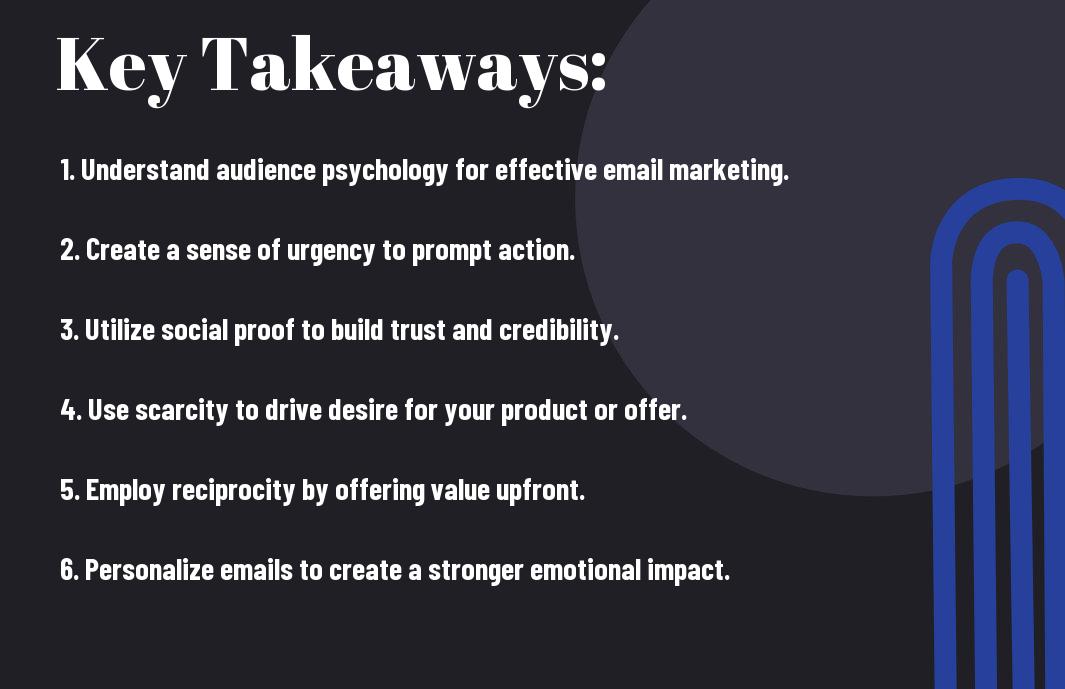
Key Takeaways:
- Understanding your audience: Identifying the psychological triggers that resonate with your audience is crucial for boosting email conversions.
- Using urgency and scarcity: Creating a sense of urgency and scarcity in your email content can prompt recipients to take immediate action.
- Personalization: Tailoring your emails to individuals can enhance the psychological impact and drive conversions.
- Social proof: Including social proof in your emails, such as testimonials or user reviews, can boost credibility and trust, leading to higher conversions.
- Emotional appeal: Leveraging emotional triggers such as fear, joy, or excitement can resonate with recipients and encourage them to engage with your email content.
- Using reciprocity: Offering value upfront can trigger the psychological principle of reciprocity, encouraging recipients to reciprocate by converting.
- Consistency and commitment: Encouraging small commitments through email interactions can influence recipients to make larger commitments, ultimately leading to higher conversions.
The Psychology Behind Email Engagement
Obviously, the success of email marketing campaigns heavily relies on understanding the psychological principles that drive engagement and conversion. By tapping into these psychological triggers, marketers can effectively craft and deliver emails that resonate with their audience, leading to higher open and click-through rates.
Principles of Influence and Persuasion
An understanding of the principles of influence and persuasion, as outlined by Robert Cialdini, is essential for creating compelling emails. Reciprocity, social proof, authority, consistency, liking, and scarcity are powerful drivers of human behavior that can be leveraged to create emails that appeal to the recipient’s subconscious desires, ultimately leading to higher conversion rates.
Cognitive Biases Affecting Email Perception
Influence, cognitive biases play a significant role in how emails are perceived and acted upon by recipients. By understanding cognitive biases such as anchoring, confirmation bias, availability heuristic, and the framing effect, marketers can tailor their emails to manipulate recipients’ perceptions and guide them towards the desired actions.
With a deep understanding of these cognitive biases, marketers can create highly persuasive and impactful email campaigns that appeal to the subconscious of their audience, ultimately leading to higher conversions and engagement.

Personalization as a Conversion Catalyst
Even with the advancement of automation and mass email marketing, personalization remains a powerful tool for enhancing email conversions. By tailoring content to the individual and providing dynamic content and personalized recommendations, companies can significantly boost engagement and conversion rates.
Tailoring Content to the Individual
Individual preferences and behaviors can vary drastically, and addressing these differences is key to enhancing email conversions. Personalizing email content to cater to the interests, needs, and preferences of each recipient can create a stronger emotional connection and resonate more deeply. By utilizing data on past interactions, purchasing history, and personal preferences, companies can create more meaningful and relevant email content that captures the attention of recipients.
Dynamic Content and Personalized Recommendations
With the use of dynamic content and personalized recommendations, companies can further enhance personalization in their email marketing efforts. By leveraging algorithms and machine learning, companies can provide individualized product recommendations and content that are most likely to resonate with the recipient. This level of personalization not only increases the relevance of the email content but also enhances the overall user experience, leading to higher engagement and conversion rates.
Dynamic content and personalized recommendations are particularly effective in nurturing leads and encouraging repeat purchases by presenting relevant products or content based on the recipient’s past behavior and preferences, ultimately driving higher conversions and revenue.
Crafting Compelling Subject Lines
Now, let’s delve into the art of crafting compelling subject lines for your marketing emails. The subject line is the first thing your recipients see, and it can make or break your email open rates. With the right combination of psychological triggers, you can create subject lines that entice recipients to click and engage with your content.
Power Words That Trigger Action
Words have the power to evoke emotions and prompt action. When crafting your subject lines, consider the use of power words that resonate with your target audience. Words like “exclusive,” “limited time,” “free,” and “urgent” can create a sense of urgency and excitement, prompting recipients to take immediate action.
Utilizing these power words strategically can compel your recipients to open your email and explore the content inside, leading to higher email conversions.
Leveraging Curiosity and Scarcity
Crafting subject lines that pique curiosity and convey a sense of scarcity can drive higher email open rates. Utilizing phrases like “don’t miss out,” “sneak peek,” and “reveal all” can spark curiosity and compel recipients to open your email to satisfy their curiosity.
To further leverage the psychological trigger of scarcity, consider incorporating phrases like “limited slots available” or “exclusive offer for a select few” to convey a sense of urgency and scarcity, prompting recipients to take action.
Timing and Frequency
Not every email sent at any time will have the desired outcome. Understanding the optimal timing and frequency of your emails can significantly impact your email conversions.
Identifying Optimal Send Times
The timing of your email send is crucial for achieving the highest open and click-through rates. Research has shown that the best times to send emails are typically mid-week, particularly Tuesdays and Thursdays, between 10 am and 2 pm. However, it’s important to consider your target audience’s behavior and preferences when identifying the optimal send times for your email campaigns.
Determining Appropriate Email Cadence
Determining the appropriate email cadence involves finding the balance between staying in top-of-mind for your subscribers without overwhelming them with too many emails. With the right email cadence, you can keep your audience engaged while not driving them to unsubscribe due to excessive communication.
With the right timing and frequency, you can maximize the impact of your email marketing efforts and enhance your conversions by effectively reaching and engaging your target audience.
Visual Triggers and Email Design
Despite the content of your email, the design and visual elements play a crucial role in triggering psychological responses from your subscribers. According to The Prism Global Marketing Solutions, incorporating 7 Emotional Triggers to Keep Your Email Subscribers Hooked in your email design can significantly enhance your email conversions.
Color Psychology and Branding
Any savvy marketer knows the power of color psychology in influencing emotions and behaviors. The choice of colors in your email design can evoke positive or negative emotions, leading to high or low conversions. Aligning the color scheme with your brand identity can establish a strong and consistent brand image, creating a sense of trust and familiarity among your target audiences.
Layouts That Lead to Conversion
Color plays a vital role in guiding the visual flow within your email. The strategic use of colors can direct the attention of your subscribers towards important elements such as call-to-action buttons, product images, and promotional offers. Layouts that are clutter-free and have a clear hierarchy of information are more likely to engage and convert your audience.
Layouts that incorporate visual triggers such as compelling images, well-placed buttons, and strategic use of white space can enhance the overall impact and effectiveness of your email campaigns.
Call-To-Action Strategies
Your email call-to-action (CTA) is arguably the most important element for driving conversions. With the right strategies, you can use psychological triggers to enhance the effectiveness of your CTAs and drive more action from your email subscribers.
Positioning and Design of CTAs
Strategies for positioning and designing your CTAs can significantly impact conversion rates. Consider the placement of your CTA buttons within your email body and the use of contrasting colors to make them stand out. Additionally, consider the size and shape of your CTA buttons to make them more visually appealing and attention-grabbing. A well-designed CTA will draw the eye and prompt action from your recipients.
Urgency and Exclusivity to Prompt Action
Design your CTAs with a sense of urgency and exclusivity to prompt immediate action from your email recipients. Create a sense of urgency by using time-limited offers or emphasizing limited availability. Additionally, impart a sense of exclusivity by offering special promotions or early access to products or content. These psychological triggers can create a fear of missing out and prompt your recipients to take action.
Plus, using urgent language such as “act now” or “limited time offer” can further enhance the sense of urgency in your CTAs, prompting quick action from your email subscribers. Incorporating exclusive language such as “exclusive access” or “members-only” can also create a feeling of exclusivity and drive more conversions.
Testing and Optimization
Keep testing and optimizing your email campaigns to maximize their effectiveness. By consistently analyzing data and making changes, you can ensure that your psychological triggers are having the desired impact on your subscribers.
A/B Testing for Email Campaigns
With A/B testing, you can compare two versions of an email to see which performs better. This allows you to experiment with different psychological triggers, such as urgency, social proof, or scarcity, and determine which ones resonate most with your audiences. By systematically testing different elements of your emails, you can identify the most effective strategies for improving conversion rates.
Analyzing Data to Enhance Performance
Testing and analyzing the data from your email campaigns is crucial for enhancing performance. By closely examining metrics such as open rates, click-through rates, and conversions, you can gain valuable insights into how your subscribers are responding to your emails. This information can then be used to refine your messaging and optimize the use of psychological triggers for greater engagement and conversions.
The insights gained from analyzing data are essential for refining and improving your email marketing strategies. By identifying which psychological triggers are most effective and adapting your content accordingly, you can maximize the impact of your email campaigns and achieve better results for your business.
Ethical Considerations and Best Practices
Unlike other marketing tactics, using psychological triggers in email marketing comes with ethical considerations. It is important to find a balance between persuasion and honesty to maintain the trust and loyalty of your subscribers. By following best practices, you can ensure that your email campaigns are both effective and ethical.
Balancing Persuasion with Honesty
Considerations must be given to the use of psychological triggers in email marketing. While it is important to use persuasive language and tactics to encourage conversions, it is equally important to be honest and transparent in your communication. Resorting to deceptive tactics or false claims can lead to a loss of trust and credibility among your subscribers, ultimately damaging your brand reputation. It is crucial to strike a balance between using psychological triggers to persuade and maintaining the honesty of your messaging.
Maintaining Subscriber Trust and Loyalty
Persuasion tactics in email marketing should always be used with the goal of building and maintaining subscriber trust and loyalty. Subscribers who feel manipulated or deceived are likely to unsubscribe and may even spread negative word-of-mouth about your brand. To maintain trust and loyalty, it is important to consistently deliver on your promises, provide value to your subscribers, and ensure that your communications are relevant and beneficial to them.
Practices that prioritize maintaining subscriber trust and loyalty include providing valuable content, respecting subscriber preferences and privacy, and being transparent about your marketing tactics. By prioritizing these practices, you can build long-term relationships with your subscribers and establish a positive reputation for your brand.
Conclusion
Ultimately, utilizing psychological triggers in email marketing can greatly enhance email conversions. By understanding the principles of persuasion, social proof, scarcity, and urgency, marketers can craft compelling emails that drive action and engagement. It is important to use these triggers thoughtfully and ethically, with a deep understanding of the target audience and their motivations. With the right approach, psychological triggers can be a powerful tool in boosting email conversions.
As email marketing continues to be a crucial component of digital marketing strategies, leveraging psychological triggers can give brands a competitive edge in engaging and converting their audience. By incorporating these triggers into email content, marketers can tap into the subconscious desires and emotions of subscribers, ultimately driving higher open rates, click-through rates, and conversions. It is essential for marketers to continually test and optimize their email campaigns to understand which psychological triggers resonate most effectively with their audience, leading to sustained success in email marketing efforts.
FAQ
Q: What are psychological triggers in email conversions?
A: Psychological triggers are emotional or psychological cues that influence and persuade individuals to take a specific action, such as making a purchase or signing up for a newsletter, when included in email marketing campaigns.
Q: How can you use psychological triggers to enhance email conversions?
A: You can use psychological triggers in email marketing by incorporating elements such as scarcity, social proof, reciprocity, and urgency to create a sense of trust, urgency, and personalization that motivates recipients to act on the call-to-action within the email.
Q: What is scarcity and how can it be used in email marketing?
A: Scarcity is the perception that a product or opportunity is limited. In email marketing, you can use scarcity by highlighting limited-time offers, low stock availability, or exclusive access to incentivize recipients to take action before the opportunity is no longer available.
Q: What is social proof and how does it impact email conversions?
A: Social proof is the influence that the actions and attitudes of others have on an individual’s own behavior. Including customer testimonials, reviews, or endorsements in your emails can create trust and credibility, increasing the likelihood of conversions.
Q: How can reciprocity be leveraged in email marketing?
A: Reciprocity is the belief that if someone does something for you, you should do something in return. In email marketing, offering free resources, exclusive content, or personalized recommendations can trigger a sense of obligation in recipients, leading to increased conversions.
Q: Why is urgency important in email conversions?
A: Urgency creates a sense of immediacy and importance, motivating recipients to act quickly. Including limited-time offers, countdowns, or expiration reminders in your emails can drive conversions by compelling recipients to take action before it’s too late.
Q: What role does personalization play in leveraging psychological triggers for email conversions?
A: Personalization in email marketing, such as addressing recipients by name, tailoring content based on their preferences, and recommending products based on their past behavior, can create a sense of relevance and individual attention, increasing the likelihood of conversions.
Related posts: