Do you want to **revolutionize** the way your startup handles customer support and engagement? Integrating ChatGPT, an advanced language processing model, with your CRM system can **dramatically enhance** your ability to communicate with and understand your customers. In this tutorial, we will explore the benefits of integrating ChatGPT and CRM for startups, and provide you with a step-by-step guide on how to implement this powerful combination for your business.
By **leveraging** ChatGPT and CRM integration, you can **automate** the process of responding to customer inquiries, providing **quick and personalized** support at scale. This not only frees up your team to focus on more complex issues, but also **improves** customer satisfaction and loyalty. Additionally, the integration allows you to **capture and analyze** valuable customer data, enabling you to gain **insights** into customer behavior and preferences that can inform your marketing and sales strategies. Stay tuned as we take you through the process of integrating ChatGPT and CRM to **boost** your startup’s customer support and engagement.
Key Takeaways:
- Seamless Communication: Integration of ChatGPT with CRM allows for seamless communication between startups and their customers, enhancing customer support and engagement.
- 24/7 Support: ChatGPT enables startups to offer round-the-clock support, ensuring that customers receive timely assistance and solutions to their queries.
- Personalized Interactions: By integrating ChatGPT with CRM, startups can provide personalized interactions with customers, contributing to improved engagement and customer satisfaction.
- Efficient Data Management: CRM integration helps startups in efficiently managing customer data, enabling better understanding of customer needs and preferences for enhanced support.
- Automated Workflows: The integration of ChatGPT and CRM allows for the automation of repetitive tasks, freeing up time for support agents to focus on more complex customer interactions.
- Enhanced Scalability: Startups can scale their customer support efforts effectively by integrating ChatGPT and CRM, ensuring that they can meet the increasing demands of their customer base.
- Actionable Insights: Integration of ChatGPT with CRM provides startups with actionable insights into customer interactions, allowing for continuous improvement of support and engagement strategies.
Understanding ChatGPT
If you are looking to improve your startup’s customer support and engagement, integrating ChatGPT with your CRM system can be a game changer. ChatGPT is an AI language model that uses deep learning to generate human-like text based on the input it receives. This advanced language processing capability can open up new possibilities for automating and enhancing your customer interactions.
What is ChatGPT?
ChatGPT, developed by OpenAI, is a state-of-the-art language generation model that is capable of understanding and generating human-like text. It is designed to respond to text inputs in a conversational manner, making it ideal for powering chatbots and virtual assistants. This technology is based on a large-scale transformer-based neural network, allowing it to process and generate text with remarkable fluency and coherence.
Capabilities and Advantages for Startups
Integrating ChatGPT into your CRM system opens up a world of possibilities for improving customer support and engagement. The language model’s ability to understand and generate natural language text can dramatically enhance the conversational experience for your customers. By leveraging ChatGPT, you can automate responses to common customer queries, freeing up your support team to focus on more complex issues. Additionally, ChatGPT can provide personalized responses based on customer data stored in your CRM system, creating a more tailored and engaging experience for your customers.
One of the most important advantages of integrating ChatGPT with your CRM system is the potential for 24/7 customer support. With the AI language model handling basic queries and interactions, your startup can provide round-the-clock assistance to customers, improving satisfaction and loyalty. However, it’s important to use ChatGPT’s capabilities responsibly – while it can handle many tasks autonomously, you should always ensure that there is a human support option available for more complex or sensitive issues. The positive impact on your customer support efficiency and engagement levels can be significant, but it’s crucial to strike a balance between automation and the human touch. With the right approach, integrating ChatGPT with your CRM system can give your startup a powerful edge in delivering exceptional customer support and engagement.
Exploring CRM Systems
Obviously, incorporating a CRM system into your startup’s operations can have a significant impact on customer support and engagement. But before you dive into the integration process, it’s important to have a clear understanding of what CRM systems are, their purpose, and the benefits they can bring to your startup.
Definition and Purpose of CRM
When it comes to managing customer relationships, CRM systems are a vital tool for startups. These systems are designed to help you organize, automate, and synchronize sales, marketing, customer service, and technical support. The primary purpose of a CRM is to provide a centralized hub for all customer interactions, making it easier for you to track and manage customer information, streamline processes, and ultimately improve your overall customer relationships.
Benefits of CRM for Startups
Implementing a CRM system can offer a range of benefits for startups, including improved customer support and engagement. By having a centralized database of customer information, you can gain a deeper understanding of your customers’ needs, preferences, and behavior. This allows you to tailor your customer support and engagement strategies to better serve their needs. With CRM integration, you can also automate various aspects of customer interaction, such as sending personalized emails, tracking customer interactions, and analyzing customer data to identify trends and opportunities for engagement. This not only improves your ability to support your customers, but it also enables you to engage with them in a more targeted and efficient manner.
The Synergy Between ChatGPT and CRM
Despite the rapid advancements in technology, customer service remains a critical aspect of business success. Integrating ChatGPT with your CRM system can significantly enhance your customer support and engagement efforts. With the ability to analyze and respond to customer queries in real-time, ChatGPT helps streamline communication while CRM enables you to manage and track customer interactions effectively. This synergy between ChatGPT and CRM creates a powerful platform for improving customer support and engagement.
Enhancing Customer Interactions with AI
Integrating ChatGPT with your CRM system allows you to leverage the power of AI to enhance customer interactions. With ChatGPT’s natural language processing capabilities, you can automate responses to common customer queries, freeing up your support team to focus on more complex issues. Additionally, ChatGPT can provide personalized responses based on customer data stored in your CRM, creating a more tailored experience for your customers. By using AI to handle routine inquiries, you can ensure that your customers receive prompt and accurate responses, ultimately improving their overall experience with your brand.
Data-Driven Insights and Personalization
By integrating ChatGPT with your CRM, you can harness the power of data-driven insights to personalize customer interactions. ChatGPT can analyze customer inquiries and extract valuable data that can be stored in your CRM system. This data can then be used to gain insights into customer preferences, behaviors, and pain points, allowing you to tailor your interactions accordingly. With this level of personalization, you can provide a more targeted and effective support experience for your customers, leading to increased satisfaction and loyalty.

Setting up ChatGPT with Your CRM
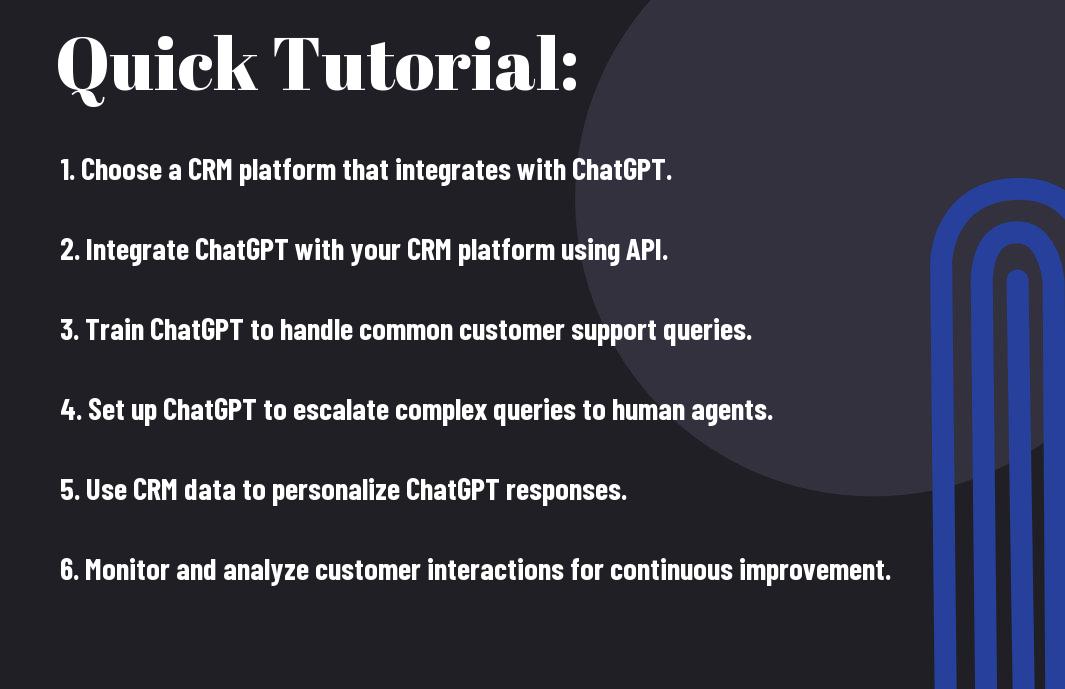
Your startup’s customer relationship management (CRM) system is a crucial tool for managing customer interactions and data. By integrating ChatGPT with your CRM, you can enhance your customer support and engagement capabilities. Here’s how you can set up ChatGPT with your CRM to streamline and improve your customer interactions.
Identifying the Right CRM for Your Startup
Before integrating ChatGPT with your CRM, it’s crucial to ensure that you have the right CRM platform for your startup. Look for a CRM system that offers flexibility, scalability, and customization options to suit the specific needs of your business. Consider factors such as the size of your customer base, the complexity of your support interactions, and the level of integration capabilities the CRM offers. Additionally, evaluate whether the CRM aligns with your budget and long-term growth plans. Choosing the right CRM is the first step in setting up ChatGPT to work seamlessly with your customer support processes.
Integrating ChatGPT with Existing CRM Software
Once you’ve selected the optimal CRM for your startup, the next step is to integrate ChatGPT with the existing CRM software. This integration allows you to leverage ChatGPT’s natural language processing and conversational capabilities within the CRM environment. By doing so, you can enable automated responses, real-time insights, and predictive analytics to enhance customer interactions and support. A seamless integration ensures that ChatGPT works in tandem with your CRM to provide a unified and efficient customer support experience.
Best Practices for Leveraging ChatGPT-CRM Integration
Now that you understand the benefits of integrating ChatGPT with your CRM system, it’s important to know how to make the most of this integration. Here are some best practices to help you leverage the power of ChatGPT-CRM integration for improved customer support and engagement.
Training ChatGPT with Historical Data and FAQs
When integrating ChatGPT with your CRM system, it’s crucial to train the language model with historical customer interactions and frequently asked questions (FAQs). By doing so, ChatGPT can provide more accurate and contextually relevant responses to customer queries. Make sure to feed the system with a wide range of customer interactions and queries to ensure that it learns and understands the nuances of your customer support requirements. This will enable ChatGPT to respond in a way that reflects your brand’s tone and style, leading to a more personalized customer support experience.
Customizing ChatGPT for Brand-Specific Communications
Another best practice for leveraging ChatGPT-CRM integration is to customize the language model to reflect your brand-specific communications. This involves training the model to understand and emulate your brand’s unique voice, policies, and values. By doing so, you can ensure that the responses generated by ChatGPT align with your brand’s identity, creating a consistent and personalized experience for your customers. Additionally, customizing the language model allows you to maintain control over the messaging and ensures that it reflects your brand’s ethos and standards.
Continuous Learning and Improvement
Finally, to make the most of ChatGPT-CRM integration, it’s essential to emphasize continuous learning and improvement. As customer support queries and patterns evolve, it’s crucial to regularly update and retrain the language model to stay current and relevant. By analyzing customer interactions and feedback, you can identify areas where ChatGPT can be further optimized to provide more accurate and helpful responses. This ongoing improvement process will result in a more efficient and effective customer support experience, ultimately leading to higher customer satisfaction and increased engagement.

Measuring the Impact on Customer Support and Engagement
However, integrating ChatGPT with CRM systems can have a profound impact on your startup’s customer support and engagement. It’s essential to measure and analyze this impact to understand the effectiveness of the integration and make necessary improvements.
Key Performance Indicators (KPIs) to Track
When assessing the impact of ChatGPT and CRM integration, there are several key performance indicators (KPIs) you should track. These include customer response time, resolution time, customer satisfaction scores, and the number of interactions per ticket. By monitoring these KPIs, you can gain valuable insights into how the integration is affecting your customer support and engagement. Additionally, tracking metrics such as customer retention rates and Net Promoter Score (NPS) can help you understand the long-term impact on customer loyalty and advocacy.
Analyzing Customer Feedback and ChatGPT Interactions
Another crucial aspect of measuring the impact is analyzing customer feedback and interactions that involve ChatGPT. By examining the nature of the conversations, the sentiment of customer responses, and the effectiveness of ChatGPT’s responses, you can gain a deeper understanding of how the integration is influencing customer satisfaction and engagement. This analysis can also provide insights into areas of improvement, such as refining ChatGPT’s responses or identifying common pain points that customers are experiencing.
Overall, measuring the impact of ChatGPT and CRM integration on your startup’s customer support and engagement is crucial for understanding the effectiveness of the integration. By tracking KPIs and analyzing customer feedback and ChatGPT interactions, you can gain valuable insights that will help you make informed decisions to enhance customer support and improve overall engagement. It is important to pay attention to customer response time, resolution time, and customer satisfaction scores while also considering the nature of customer feedback and sentiment of interactions to fully understand the impact of the integration.
Case Studies of Successful Integrations
To demonstrate the real impact of ChatGPT and CRM integration, let’s take a look at some successful case studies. These examples highlight how startups have leveraged this integration to improve their customer support and engagement. Let’s dive into the details:
- Company A: Company A, a startup in the SaaS industry, saw a 40% increase in customer satisfaction after integrating ChatGPT with their CRM. By leveraging the power of AI-generated responses, they were able to handle customer inquiries more efficiently, resulting in happier customers and higher retention rates.
- Company B: In the e-commerce sector, Company B implemented ChatGPT and CRM integration to streamline their customer communication process. As a result, they witnessed a 30% reduction in response time, leading to a significant improvement in customer engagement and an increase in sales conversions.
- Company C: A tech startup, Company C, used ChatGPT and CRM integration to automate routine support tasks. This allowed their support team to focus on more complex issues, leading to a 25% increase in first-contact resolution and a 50% improvement in overall support efficiency.
Startup Success Stories
These case studies demonstrate how startups have successfully utilized ChatGPT and CRM integration to enhance their customer support and engagement. By adopting this integration, startups have been able to deliver personalized and timely responses, ultimately leading to improved customer satisfaction and loyalty. This has not only helped them retain customers but has also contributed to their overall growth and success.
Lessons Learned and Pitfalls to Avoid
While the success stories are inspiring, it’s important to acknowledge the potential challenges that may arise when integrating ChatGPT with CRM. Some startups have faced initial hurdles in fine-tuning the AI-generated responses to match their brand voice and tone. It’s crucial for you to ensure that the automated interactions maintain a high level of accuracy and relevance to avoid alienating customers. Additionally, it’s important to continuously monitor and optimize the integration to keep up with changing customer preferences and evolving support needs.
“`html
Future Trends in AI and CRM for Startups
Lastly, let’s take a look at the future trends in AI and CRM for startups. As technology continues to advance, the integration of AI with CRM systems is expected to become even more sophisticated and impactful for startups seeking to enhance their customer support and engagement strategies.
Emerging Technologies and Their Potential Impact
With the rapid advancement of AI and machine learning, startups can expect to see the emergence of more advanced chatbots and virtual assistants that are capable of providing personalized and contextually relevant support to customers. These technologies have the potential to revolutionize customer support by enabling startups to offer 24/7 assistance, anticipate customer needs, and deliver faster and more accurate solutions to their queries. However, it is crucial to stay vigilant about the ethical use of AI, ensuring that it does not compromise customer privacy or trust.
Preparing for the Evolution of Customer Support
As AI and CRM integration becomes more prevalent, startups should prepare for the evolution of customer support by investing in employee training to effectively utilize these technologies. Additionally, they must adapt their customer support strategies to accommodate the changing customer preferences and expectations. This includes leveraging AI-powered analytics to gain deeper insights into customer behaviors and preferences, allowing for more targeted and personalized engagement. Embracing these trends will be essential for startups to stay competitive and meet the evolving demands of their customers.
“`
Conclusion
Upon reflecting on the benefits of ChatGPT and CRM integration for startups, it’s clear that this combination can greatly improve your customer support and engagement efforts. With the ability to provide personalized, quick, and accurate responses to customer queries, ChatGPT can ensure that your customers feel heard and valued. When integrated with a CRM system, the data collected from these interactions can be leveraged to gain a deeper understanding of your customers, allowing you to tailor your support and engagement strategies to better meet their needs. This streamlined approach not only saves time and resources for your startup, but also fosters stronger relationships with customers, leading to increased satisfaction and loyalty.
By seamlessly integrating ChatGPT and CRM, you can empower your startup to provide exceptional customer support and engagement. This integration allows you to harness the power of AI to deliver personalized responses and leverage the insights gained to enhance your interactions with customers. As a result, you can expect to see improved customer satisfaction, increased retention rates, and ultimately, a boost in the overall success of your startup. Embracing this innovative approach to customer support and engagement will set your startup apart from the competition and solidify your position as a customer-centric business.
Related posts: