With the continuous advancement in technology, implementing an AI chatbot for merchant services can revolutionize your payment processing system. This concise guide breaks down the 10 crucial steps to seamlessly integrate AI chatbots into your business, ensuring efficiency and customer satisfaction.
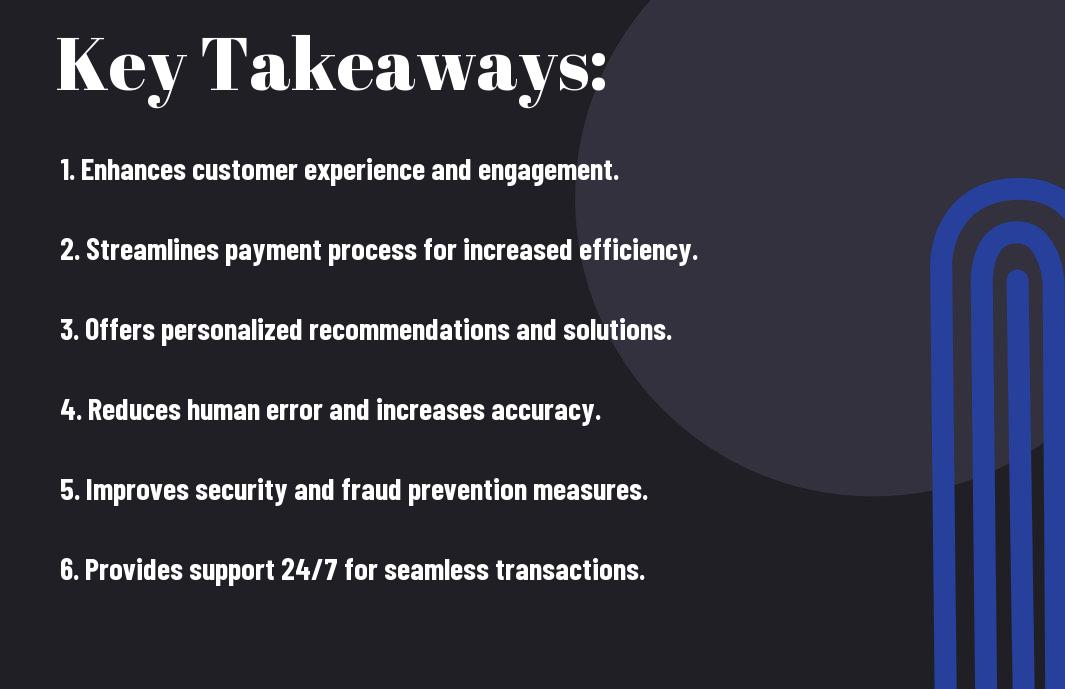
Key Takeaways:
- AI chatbots can revolutionize merchant services by providing automated payment processing solutions.
- Implementing an AI chatbot for payment processing can enhance customer experience by providing quick and seamless transactions.
- Integrating AI technology in merchant services can reduce human error and increase operational efficiency.
- AI chatbots can be programmed to handle payment inquiries, fraud detection, and payment security effectively.
- By implementing an AI chatbot, businesses can save time and resources that would otherwise be spent on manual payment processing.
- Training the AI chatbot with machine learning algorithms can improve its accuracy and response time over time.
- Regularly updating and maintaining the AI chatbot is imperative to ensure it continuously meets the evolving needs of the merchant services industry.
Assess Business Needs
Analyze transactions
To implement an AI chatbot for merchant services, begin by analyzing transactions to understand the volume, frequency, and types of payments your business processes. This data will help in tailoring the chatbot’s functionalities to meet the specific needs of your business and customers.
Identify pain points
To streamline payment processing, identify pain points such as long wait times for customer queries, manual entry errors, or complex payment procedures. By understanding these pain points, you can design the chatbot to address these issues efficiently and effectively.
While identifying pain points, it is crucial to prioritize areas that have the most significant impact on your business operations. By focusing on resolving these pain points first, you can create a more seamless payment processing experience for both your business and customers.
Assessing your business needs is the foundation for implementing an AI chatbot for merchant services successfully. By thoroughly analyzing transactions and identifying pain points, you can ensure that the chatbot is tailored to improve efficiency, customer satisfaction, and overall business performance.
Choose Suitable AI
Evaluate AI Solutions
If you’re looking to implement an AI chatbot for payment processing, it’s crucial to evaluate different AI solutions available in the market. Consider factors such as the chatbot’s natural language processing capabilities, integration with existing systems, scalability, and customization options. Ensure the AI can handle complex payment queries and provide seamless user experiences.
Decision-making capabilities
You’ll need to choose an AI chatbot that has robust decision-making capabilities to handle a variety of payment scenarios and customer inquiries effectively. Look for AI solutions that can analyze data in real-time, learn from past interactions, and make informed decisions autonomously to streamline the payment process. This feature is crucial for enhancing operational efficiency and providing quick resolutions to customers.
A chatbot with strong decision-making capabilities can accurately assess payment risks, detect fraudulent activities, and suggest appropriate payment solutions, all in real-time. This capability not only improves the overall customer experience but also helps in preventing potential financial losses for merchants.
Design Conversational Flow
Not Effortless Transactions — Enhancing Merchant Services with AI Chatbot for Small Businesses need to overlook the importance of designing a smooth conversational flow for their AI chatbot. This crucial step can significantly impact user experience and the efficiency of payment processing.
Script dialogues
For a successful implementation of an AI chatbot for payment processing, well-crafted script dialogues are necessary. Keep the conversations natural and engaging while guiding users through the payment process seamlessly. Clear and concise messages with personalized touches can enhance user interaction and build trust.
Implement branching paths
You’ll want to create branching paths in your chatbot’s conversational flow to account for different user responses and scenarios. By implementing branching paths, you can cater to a variety of user needs and ensure a personalized experience for each interaction. This will help in resolving user queries efficiently and directing them to the right payment options.
To ensure the effectiveness of branching paths, you must thoroughly map out various user journeys and anticipate possible outcomes. By considering different pathways based on user input, you can design a chatbot that can handle complex payment processes with ease.

Integrate Payment Gateways
Select gateways
To seamlessly integrate AI chatbots for merchant services, selecting the right payment gateways is crucial. Ensure that the chosen gateways are secure, reliable, and offer a wide range of payment options to cater to diverse customer needs. Popular choices like PayPal, Stripe, and Square are known for their robust features and integration capabilities.
Ensure compatibility
To ensure compatibility between the AI chatbot and the payment gateway, it is imperative to conduct thorough testing during the integration process. Compatibility issues can lead to failed transactions, security vulnerabilities, and a poor user experience. Make sure that the chatbot can communicate effectively with the chosen gateway and handle different types of transactions seamlessly.
Gateways that are not compatible with the AI chatbot can result in payment failures, loss of customer trust, and potential security breaches. It is imperative to double-check the integration to avoid any compatibility issues that can hinder the smooth operation of the payment processing system.
Ensure Security Compliance
Data protection protocols
One of the critical aspects of implementing an AI chatbot for merchant services is to establish robust data protection protocols. Ensure that all sensitive customer information is encrypted both in transit and at rest. Implement access controls to restrict data access to only authorized personnel. Regularly update security patches and software to prevent vulnerabilities.
Regular security audits
The key to maintaining a secure environment for payment processing is to conduct regular security audits. By scheduling routine assessments, you can identify and address potential security weaknesses before they are exploited by cybercriminals. Engage third-party security experts to perform penetration testing and evaluate your system’s resilience against external threats.
To ensure maximum security compliance, it is important to stay proactive in your approach to data protection. Regularly updating security protocols and conducting thorough security audits will guarantee that your AI chatbot for merchant services remains a secure platform for processing payments. Stay informed about the latest security trends and continuously educate your team on best practices to mitigate security risks.
Train AI Model
Import transaction data
On this initial step to train your AI model, importing transaction data is crucial. This data serves as the foundation for the AI to learn and understand various payment scenarios. Ensure the data is comprehensive, accurate, and up-to-date to enhance the efficiency of your AI chatbot.
Refine response accuracy
You’ll want to continuously refine response accuracy to ensure your AI chatbot provides the best possible customer service. This can be done through regular monitoring and analysis of interactions, identifying areas of improvement, and updating the AI model accordingly to enhance its accuracy and effectiveness.
Importing detailed transaction data such as customer inquiries, successful transactions, and common issues can significantly improve the accuracy of your AI responses. By analyzing patterns and trends in the data, you can proactively train your AI model to anticipate customer needs and provide tailored solutions, ultimately enhancing the overall customer experience.
Test Chatbot Performance
Conduct beta testing
Many organizations conduct beta testing to assess their chatbot’s performance before full implementation. To ensure a smooth user experience, beta testing involves a small group of users interacting with the chatbot to identify any potential bugs or issues that need to be addressed.
User feedback analysis
Many organizations analyze user feedback to continuously improve their chatbot’s performance. User feedback is an invaluable source of information that can provide insights into user preferences, pain points, and areas for enhancement. With careful analysis, businesses can optimize their chatbot to better serve their customers and streamline payment processing.
Deploy Chatbot
Once again, deploying a chatbot for merchant services can revolutionize the payment processing experience for customers. By implementing AI technology, merchants can streamline transactions, offer personalized assistance, and provide efficient customer support.
Go-live strategy
One crucial aspect of deploying a chatbot is creating a comprehensive go-live strategy. One should outline the deployment timeline, set performance metrics, conduct thorough testing, and provide training to customer support teams to ensure a smooth transition.
Multi-platform integration
With any chatbot deployment, integrating the AI technology across multiple platforms is crucial for maximizing its impact. This includes incorporating the chatbot into websites, mobile apps, social media channels, and other digital touchpoints to reach customers wherever they are.
Multi-platform integration allows merchants to offer a seamless payment experience across all platforms, enhancing customer engagement and driving sales. By leveraging AI chatbots in this way, merchants can stay ahead of the competition and meet the evolving expectations of modern consumers.
Monitor and Optimize
Track KPIs
Now is the time to start monitoring key performance indicators (KPIs) to ensure that your AI chatbot for merchant services is performing at its best. Littleby little, track metrics like customer satisfaction ratings, response times, successful transactions, and user retention rates. These KPIs will give you valuable insights into the effectiveness of your chatbot and help you identify areas for improvement.
Continuous Improvement
Now, you have set up your AI chatbot for merchant services and started tracking KPIs, but the journey doesn’t stop there. You need to continuously strive for improvement to stay ahead in the game. You can achieve this by regularly analyzing KPI data, gathering feedback from users, and implementing necessary updates to enhance the chatbot’s performance. Your commitment to continuous improvement will result in a more efficient and user-friendly payment processing experience.
Continuous improvement is crucial in the world of AI chatbots for merchant services. By staying proactive and making regular enhancements to your chatbot based on performance data and user feedback, you can ensure that it remains relevant and effective in meeting the evolving needs of your customers. Embrace a mindset of constant evolution and refinement to stay competitive in the rapidly changing landscape of payment processing.
Final Words
From above steps, implementing an AI chatbot for merchant services can greatly streamline payment processing for businesses. By automating customer interactions and providing instant support, these chatbots can enhance user experience while reducing the load on customer service teams. To easily set up an AI chatbot for payment gateway services, check out this Chatbot for Payment Gateway Services template. Stay ahead of the curve by integrating AI technology into your payment processing system and offer your customers a seamless and efficient payment experience.
FAQ
Q: What is an AI chatbot in the context of merchant services?
A: An AI chatbot is a computer program that utilizes artificial intelligence to simulate conversation with users, helping them with tasks related to merchant services such as payment processing, customer inquiries, and support.
Q: What are the benefits of implementing an AI chatbot for merchant services?
A: Implementing an AI chatbot for merchant services can streamline payment processing, improve customer service, reduce human errors, increase efficiency, and provide 24/7 support to customers.
Q: How can AI chatbots improve payment processing for merchants?
A: AI chatbots can automate payment processes, assist customers with payment-related queries, detect fraudulent transactions, provide personalized recommendations, and offer secure payment options, thus enhancing the overall payment processing experience for merchants.
Q: What are the key steps to implementing an AI chatbot for merchant services?
A: The key steps to implementing an AI chatbot for merchant services include defining the chatbot’s objectives, selecting the right AI technology, designing conversation flows, integrating with payment gateways, testing the chatbot, training it with relevant data, deploying it on various channels, monitoring its performance, collecting feedback, and continuously improving its capabilities.
Q: How can merchants ensure the security of payment information when using an AI chatbot?
A: Merchants can ensure the security of payment information when using an AI chatbot by implementing data encryption, complying with industry regulations such as PCI DSS, utilizing secure payment gateways, conducting regular security audits, and keeping the chatbot software up to date with the latest security patches.
Q: What are some common challenges faced when implementing an AI chatbot for merchant services?
A: Some common challenges faced when implementing an AI chatbot for merchant services include ensuring accuracy in understanding user queries, maintaining consistent communication tone, handling complex payment scenarios, integrating with legacy systems, managing large volumes of customer data, and keeping up with evolving AI technology.
Q: How can merchants measure the ROI of implementing an AI chatbot for their merchant services?
A: Merchants can measure the ROI of implementing an AI chatbot for their merchant services by tracking key performance indicators such as cost savings from automation, increase in sales conversion rates, reduction in customer service response times, improvement in customer satisfaction scores, and overall efficiency gains achieved through the use of the AI chatbot.