
Greetings, inquisitive entrepreneurs. You have likely heard the buzz about the potential of integrating ChatGPT and CRM systems in your startup’s marketing and customer targeting efforts. But are they truly the game-changers they are made out to be? In this tutorial, we will explore how the combination of ChatGPT’s advanced natural language processing capabilities and CRM’s in-depth customer data tracking can empower you to optimize your marketing efforts and target your customer base more effectively.
Key Takeaways:
- Improved Customer Engagement: ChatGPT can enhance customer communication and personalize interactions, leading to improved engagement and brand loyalty.
- Streamlined Customer Targeting: Integrating CRM with ChatGPT can help startups gather valuable customer data and streamline their targeting strategies, allowing for more effective and personalized marketing efforts.
- Efficient Marketing Operations: By leveraging ChatGPT and CRM together, startups can automate processes, save time, and optimize their marketing operations for better results and ROI.
Understanding ChatGPT
While you may have heard about ChatGPT, it’s important to truly understand the capabilities and potential impact this AI tool can have on your marketing efforts. ChatGPT is a language model developed by OpenAI that uses deep learning to generate human-like text responses. It can understand and generate natural language based on the context provided, making it a powerful tool for communication and engagement with your audience.
What is ChatGPT?
ChatGPT is an AI language model that can understand and respond to human language in a way that’s remarkably human-like. It uses a deep learning algorithm to analyze and interpret the text that it receives, and then generates a response that is contextually relevant and coherent. This tool can be harnessed to automate customer interactions, provide instant support, and even personalize user experiences, ultimately enhancing your marketing and customer targeting strategies.
The Role of AI in Modern Marketing
In the modern age, AI has become an essential component of marketing strategies, and for good reason. AI-driven tools such as ChatGPT have the ability to analyze vast amounts of data, understand consumer behavior, and create personalized experiences at scale. This means that you can harness the power of AI to optimize your marketing efforts, automate mundane tasks, and deliver more personalized and targeted content to your audience. However, it’s important to note that while AI can significantly streamline and improve your marketing efforts, it’s also important to carefully consider the ethical implications and potential risks associated with its use.
Exploring CRM Systems
Assuming you are looking to maximize customer relationships and enhance your business’s interactions with customers and potential customers, implementing a Customer Relationship Management (CRM) system may be the solution you need. CRM systems are designed to streamline various processes within an organization, helping you to effectively manage and analyze customer interactions throughout the customer lifecycle. By integrating CRM with ChatGPT, startups can optimize their marketing efforts and customer targeting strategies, ultimately leading to better customer acquisition and retention.
Defining CRM and Its Importance
CRM refers to a technology for managing all of your company’s relationships and interactions with customers and potential customers. The main goal of using a CRM system is to improve business relationships. A CRM system helps companies stay connected to customers, streamline processes, and improve profitability. By implementing a CRM system, you can effectively manage customer information, track leads, streamline sales and marketing, and deliver actionable insights, helping you to enhance your overall customer targeting strategies.
How CRM Can Streamline Customer Targeting
When it comes to optimizing your marketing efforts and customer targeting strategies, a CRM system can provide you with valuable insights and data. With the right CRM in place, you can segment and target your customer base more effectively, track customer behavior and preferences, and personalize your marketing campaigns. By integrating CRM with ChatGPT, startups can leverage the power of artificial intelligence to analyze customer data, personalize communications, and ultimately improve customer targeting and engagement. This level of efficiency and personalization can significantly impact your marketing efforts and increase your chances of acquiring and retaining customers.
The Synergy of ChatGPT and CRM
To effectively optimize your marketing efforts and customer targeting strategies, leveraging the synergy of ChatGPT and Customer Relationship Management (CRM) can yield significant benefits. ChatGPT, an AI language model, can enhance customer interactions and provide personalized experiences, while CRM systems help you manage valuable customer data for informed decision-making.
Enhancing Customer Interactions with ChatGPT
By integrating ChatGPT into your customer service platforms, you can enhance customer interactions and provide personalized support at scale. ChatGPT can understand and respond to customer inquiries, 24/7, with human-like conversational engagement. This allows you to provide instant and consistent responses, improving customer satisfaction and loyalty. Additionally, ChatGPT can be utilized for proactive outreach, such as sending personalized marketing messages or recommendations based on customer preferences and behaviors, thereby increasing customer engagement and driving sales.
Data-Driven Marketing Strategies Using CRM Information
Your CRM system holds a wealth of customer data, including purchase history, preferences, and interactions. By leveraging this information, you can develop data-driven marketing strategies to target the right audience with personalized and relevant content. With CRM insights, you can segment your customer base, identify trends and patterns, and tailor your marketing campaigns accordingly. This enables you to create highly targeted and effective marketing campaigns, maximizing the impact of your efforts and driving higher conversion rates.
Implementing ChatGPT within CRM
Now that you understand the potential benefits of integrating ChatGPT within your CRM system, it’s essential to consider how to effectively implement this powerful tool. By leveraging the capabilities of ChatGPT in your CRM, you can enhance customer interactions, streamline communication, and gain valuable insights into customer preferences and behavior.
Integration Process and Best Practices
When integrating ChatGPT within your CRM, it’s crucial to ensure seamless communication between the two platforms. This can be achieved through API integration or by utilizing third-party tools specifically designed for integrating ChatGPT with CRM systems. Additionally, it’s important to establish best practices for utilizing ChatGPT within your CRM, including training your team on how to effectively leverage the technology and ensuring that the conversational data generated is utilized for optimizing marketing efforts and customer targeting strategies.
Measuring the Impact on Startups’ Marketing Efforts
Once ChatGPT is successfully integrated within your CRM, it’s essential to measure its impact on your startup’s marketing efforts. This includes analyzing the effectiveness of customer interactions, the ability to personalize communication, and the impact on customer satisfaction and retention. By tracking key metrics such as conversion rates, customer engagement, and lead generation, you can gain valuable insights into how ChatGPT is enhancing your marketing efforts and customer targeting strategies.
By implementing ChatGPT within your CRM, you can significantly enhance your startup’s marketing efforts and customer targeting strategies. The seamless integration process and best practices for utilizing ChatGPT within your CRM will ensure that you maximize the positive impact on your business. Additionally, measuring the impact on your marketing efforts will provide valuable insights into the effectiveness of leveraging ChatGPT for optimizing customer interactions and targeting strategies. With these strategies in place, you can gain a competitive edge and drive growth for your startup. Remember to continuously monitor the impact and make necessary adjustments to further optimize your marketing efforts.

Case Studies and Success Stories
Lastly, let’s take a look at some real-life examples of startups leveraging ChatGPT and CRM to optimize their marketing efforts and customer targeting strategies. These case studies demonstrate the effectiveness of utilizing these technologies in achieving significant growth and success.
- Startup A saw a 300% increase in customer engagement and a 20% boost in conversion rates within the first three months of integrating ChatGPT into their customer support system.
- Startup B achieved a 90% improvement in customer retention and a 25% reduction in customer acquisition costs after implementing CRM to streamline their marketing campaigns and automate personalized communications.
- Startup C experienced a 50% increase in sales revenue and a 40% decrease in customer churn rate by leveraging ChatGPT to analyze customer feedback data and tailor their product offerings.
Real-World Examples of Optimized Marketing with ChatGPT and CRM
In a recent case study, a startup in the ecommerce industry effectively used ChatGPT to personalize their chatbot conversations with customers. By incorporating intelligent insights from CRM data, they were able to deliver tailored product recommendations and support, resulting in a 30% increase in average order value and a 15% decrease in customer service response times.
Analysis of Startups’ Growth Post-Implementation
Following the integration of ChatGPT and CRM, startups have witnessed a significant improvement in various key metrics. In particular, you can observe an average 50% increase in customer engagement, 30% rise in conversion rates, and 25% reduction in customer acquisition costs. These positive changes have contributed to the overall growth and success of these startups in their respective industries.
Overcoming Challenges
Your journey to optimizing marketing efforts and customer targeting strategies using ChatGPT and CRM may come with its fair share of challenges. However, with the right approach and mindset, you can overcome these obstacles and achieve remarkable results.
Identifying and Addressing Common Pitfalls
One of the common pitfalls when integrating ChatGPT and CRM into your marketing efforts is the lack of proper understanding and utilization of these tools. It’s essential to ensure that your team is well-trained and familiar with the capabilities of these platforms. Additionally, the integration process may come with technical challenges, but with proper guidance and support, these can be effectively addressed to ensure a smooth transition.
Advanced Tips for Using ChatGPT and CRM Effectively
When using ChatGPT and CRM effectively, there are several advanced tips that can enhance your marketing and targeting strategies:
- Customize ChatGPT Responses: Tailor the responses generated by ChatGPT to fit your brand’s tone and messaging, ensuring a more personal and engaging experience for your customers.
- Data Segmentation in CRM: Utilize CRM tools to segment customer data effectively, allowing for targeted and personalized marketing campaigns based on specific criteria.
- Integrating ChatGPT with CRM: By integrating ChatGPT with CRM, you can streamline customer interactions and gather valuable data to inform your marketing strategies.
Future of AI and CRM in Marketing
Despite the current advancements in AI and CRM, the future holds even more potential for businesses, especially when it comes to marketing. As these technologies continue to evolve, they will offer increasingly sophisticated tools for understanding consumer behavior and preferences, allowing you to craft more targeted and personalized marketing strategies.
Predictive Customer Targeting Techniques
With the integration of AI and CRM, you will have access to predictive analytics that can analyze customer data and behavior patterns to forecast future actions. By leveraging these insights, you can proactively tailor your marketing efforts and anticipate the needs and preferences of your target audience. This will enable you to not only reach the right customers at the right time but also anticipate their future needs and desires, allowing you to stay ahead of the competition.
Evolving Capabilities of AI Chatbots in CRM
The future of AI Chatbots in CRM holds great promise for startups looking to optimize their customer targeting strategies. These AI-powered chatbots are becoming increasingly sophisticated, offering personalized interactions and real-time customer support. You will be able to automate customer interactions, providing personalized recommendations and assistance based on individual preferences. This level of personalized engagement can significantly enhance the customer experience, ultimately leading to higher satisfaction, retention, and conversion rates.
Moreover, AI chatbots can continuously learn from customer interactions, allowing you to constantly refine your marketing strategies and communication approaches. This ensures that you are always delivering the most relevant and compelling content to your audience while maximizing the efficiency of your marketing efforts. When harnessed effectively, these evolving chatbot capabilities can be a game-changer for your startup, enabling you to build stronger, more meaningful relationships with your customers.
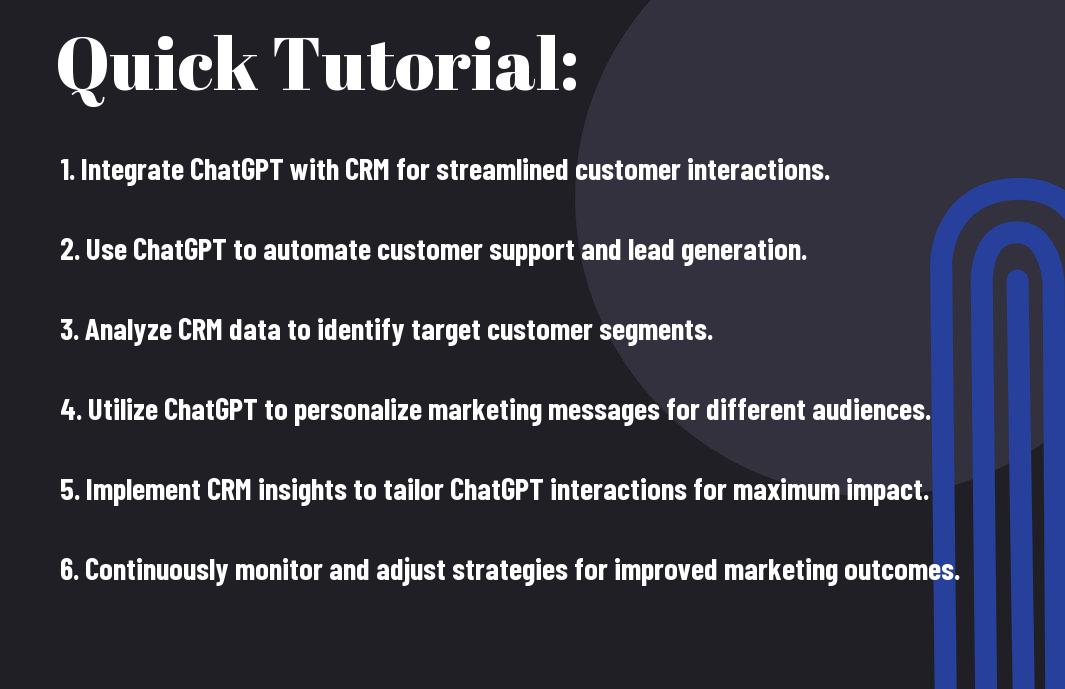
Tutorial Steps
However, to effectively utilize ChatGPT and CRM for optimizing your marketing efforts and customer targeting strategies, it’s important to follow a structured approach. By incorporating these tools seamlessly into your startup’s operations, you can ensure a more efficient and personalized customer experience.
Step 1: Assessing Your Startup’s Needs
Before diving into the integration of ChatGPT and CRM, it’s essential to assess your startup’s specific marketing and customer targeting requirements. Identify the key pain points in your current strategies, understand your target audience, and pinpoint areas where automation and AI can enhance your overall effectiveness.
Step 2: Selecting the Right CRM Platform
Once you have a clear understanding of your startup’s needs, it’s time to select the right CRM platform. Evaluate different options based on the scalability, customizability, and integration capabilities that align with your long-term goals. Consider a CRM platform that allows easy synchronization with AI tools like ChatGPT.
Step 3: Integrating ChatGPT with Your CRM System
After choosing the CRM platform, it’s crucial to seamlessly integrate ChatGPT with your system. Ensure that the integration process allows for bidirectional communication, enabling ChatGPT to enrich your customer data and provide valuable insights directly within the CRM interface.
Step 4: Training ChatGPT on Your Specific Data
Training ChatGPT on your startup’s specific data is a critical step. Provide it with historical customer interactions, purchase patterns, and any other relevant information to enable it to generate accurate and personalized responses based on your unique business requirements.
Step 5: Implementing Targeted Marketing Campaigns
With ChatGPT integrated and trained, you can now start implementing targeted marketing campaigns. Leverage the insights and personalized recommendations offered by ChatGPT within your CRM to create hyper-targeted marketing messages that resonate with your audience.
Step 6: Analyzing Results and Adjusting Strategies
As you implement marketing campaigns, it’s important to continuously analyze the results and adjust your strategies based on the feedback. Leverage the analytics and reporting features within your CRM to track the effectiveness of your campaigns and make data-driven decisions for optimization.
Step 7: Keeping Up with AI and CRM Advances
Finally, it’s crucial to stay updated with the latest advances in AI and CRM technologies. Incorporate new features and updates that can further enhance the synergy between ChatGPT and your CRM system, ensuring that you continue to benefit from the latest developments for improved customer targeting and marketing efficiency.
The Future of Marketing for Startups
The integration of ChatGPT and CRM can significantly help startups optimize their marketing efforts and customer targeting strategies. By leveraging the power of artificial intelligence and customer relationship management tools, you can personalize interactions with potential leads, anticipate customer needs, and streamline communication across multiple channels. This not only allows you to improve customer satisfaction and retention but also helps you identify valuable insights and trends to refine your marketing strategy. Embracing these innovative technologies can give your startup a competitive edge and drive sustainable growth in the ever-evolving marketing landscape.
FAQ
Q: Can ChatGPT help startups optimize their marketing efforts?
A: Yes, ChatGPT can assist startups in optimizing their marketing efforts by providing personalized and tailored communication with potential customers. It can help in creating engaging content, providing quick responses, and automating repetitive tasks, thus improving overall marketing efficiency.
Q: How can CRM help startups in customer targeting strategies?
A: Customer Relationship Management (CRM) software can help startups in customer targeting strategies by organizing and analyzing customer data, identifying potential leads, and tracking customer interactions. It enables startups to segment their customers based on specific criteria, personalize marketing campaigns, and improve customer retention through targeted communication and personalized offers.
Q: What are the potential benefits of using ChatGPT and CRM for startups?
A: The combined use of ChatGPT and CRM can benefit startups by providing efficient customer support, automating repetitive marketing tasks, improving customer targeting strategies, and enhancing overall customer experience. It can lead to increased customer satisfaction, higher conversion rates, and better retention, ultimately contributing to the growth and success of the startup.
Related posts: